
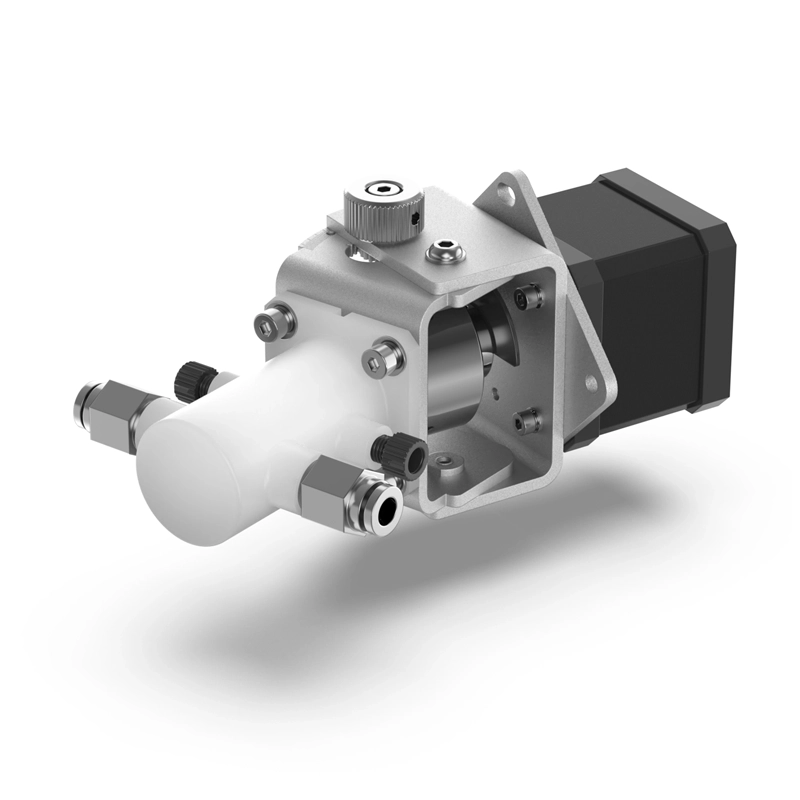
Foreach Single-head ceramic-piston valveless metering pump, 300–1200 μL/rev, for larger-volume reagent filling, buffer addition and quantitative delivery. Polyvinylidene fluoride (PVDF) head and aluminium oxide (Al₂O₃) ceramic set.
FOREACH RPL-P15 is a single-head ceramic-piston valveless metering pump with a displacement of 300–1200 μL/rev for larger-volume reagent filling, buffer dispensing and quantitative liquid supply. The shown configuration uses a polyvinylidene fluoride (PVDF) head and an aluminium oxide (Al₂O₃) ceramic set. Mechanical displacement adjustment and motor-speed selection match the required average flow. The working-fluid port is G1/8 and the wash-fluid port is 1/4-28 UNF-2B. Assess dose volume and cycle time for filling, or flow and duration for continuous supply.
Typical Applications:
Diagnostic reagent production: volumetric bottle filling, Laboratory preparation: buffer dispensing and replenishment, Analytical instrument supply: continuous metered delivery
| Product type | RPL Single-Head Valveless Metering Pump |
|---|---|
| Displacement per revolution | 300–1200 μL/rev |
| Speed | 5–300 rpm |
| Accuracy | <2% |
| Repeatability | <0.5% |
| Pressure rating | Max 150 kPa |
| Service life | 20,000,000 cycles |
| Pump head material | polyvinylidene fluoride (PVDF) |
| Plug material | polyvinylidene fluoride (PVDF) |
| Ceramic set | aluminium oxide (Al₂O₃) |
| Working-fluid port | G1/8 |
| Wash-fluid port | 1/4-28 UNF-2B |
| Overall dimensions | 78 × 78 × 160 mm |
| Weight | 900 g |
| Configuration | Custom configuration |
Displacement per revolution is not the dose or minimum reliable volume; verify actual output with the drive, liquid and circuit.
Accuracy, repeatability and life require the applicable test conditions. Confirm permitted working backpressure separately from the pressure rating.
Typical applications
RPL-P15 addresses delivery and filling tasks that need greater displacement per revolution. It may serve as a reagent filling pump, buffer dispensing pump or quantitative supply pump. Filling controls volume per container, continuous supply controls volume per unit time, and reservoir replenishment must coordinate with level control.
Diagnostic reagent production: volumetric bottle filling
In reagent production or laboratory packaging, liquid travels from a supply vessel through the pump and filling tip into each bottle. RPL-P15 can be assessed as a reagent filling pump or volumetric dispensing pump. Balance per-container volume with cycle time; different displacement settings require different revolution counts for the same target fill.
Calculation example: a nominal 5 mL fill at 1000 μL/rev requires 5 complete revolutions. At a constant 150 rpm, pump running time is theoretically 2 seconds. Container indexing, acceleration, stopping and tip motion are additional; this is not a production-line throughput claim. Calibrate the actual volume delivered at the outlet.
Before increasing speed, check inlet supply, tip restriction and droplet release. For foaming liquids, assess dispensing height and motion as well. Measure both consecutive fills and the first fill after a pause to evaluate the complete station rather than the pump alone.
Laboratory preparation: buffer dispensing and replenishment
A pump distributing premixed buffer among containers may be called a buffer dispensing pump; one refilling an intermediate reservoir may be called a replenishment pump. Neither task is the same as preparing buffer from two liquids. Single-head RPL-P15 does not independently control a concentrate-to-diluent ratio.
For repeated dispensing, match volume, displacement and operating cycles. For reservoir replenishment, level measurement or an instrument command determines start and stop. Level sensing, dry-run protection and overflow prevention belong to the system design and cannot be assumed to be included with the pump.
Include a compatible shutdown rinse when using salt-containing buffers to limit residue drying and crystallization around the piston. The G1/8 working-fluid port and 1/4-28 UNF-2B wash-fluid port serve different circuits. Connect them according to the configuration drawing and check for air introduced after replenishment.
Analytical instrument supply: continuous metered delivery
When an instrument needs liquid over an extended period, RPL-P15 can be assessed as a liquid metering pump or quantitative supply pump. Unlike per-container filling, the primary inputs are average flow, run duration and the downstream process tolerance for flow fluctuations.
Estimate nominal average flow as displacement per revolution multiplied by speed. Calculation example: 500 μL/rev × 120 rpm = 60000 μL/min, or 60 mL/min. This is an average value, not constant instantaneous flow or a substitute for measurement with the actual liquid and backpressure.
Measure output collected over a defined interval at the actual outlet resistance, and check the effect of pulsation on the downstream process. Adding a mixer or other restriction requires renewed backpressure and inlet-supply checks. Valveless construction does not by itself guarantee pulseless flow or unlimited continuous operation.
Define the fluidic task and configuration
Provide liquid composition, dose volume or continuous flow, allowable delivery time, daily run duration, inlet conditions, outlet backpressure and drive requirements. Use these inputs to size displacement and timing, then verify output in the actual circuit. Application directions are not claims of validation in every listed instrument.
Frequently Asked Questions
Valveless metering pump describes the pump mechanism and metering function. Reagent dispensing pump, titrant dosing pump and filling pump describe tasks within an instrument. These task names do not mean that every pump used in that application has the same mechanism.
Confirm the RPL-P15 configuration for your instrument
Provide liquid composition, dose volume or continuous flow, allowable delivery time, daily run duration, inlet conditions, outlet backpressure and drive requirements. Use these inputs to size displacement and timing, then verify output in the actual circuit. Application directions are not claims of validation in every listed instrument.