
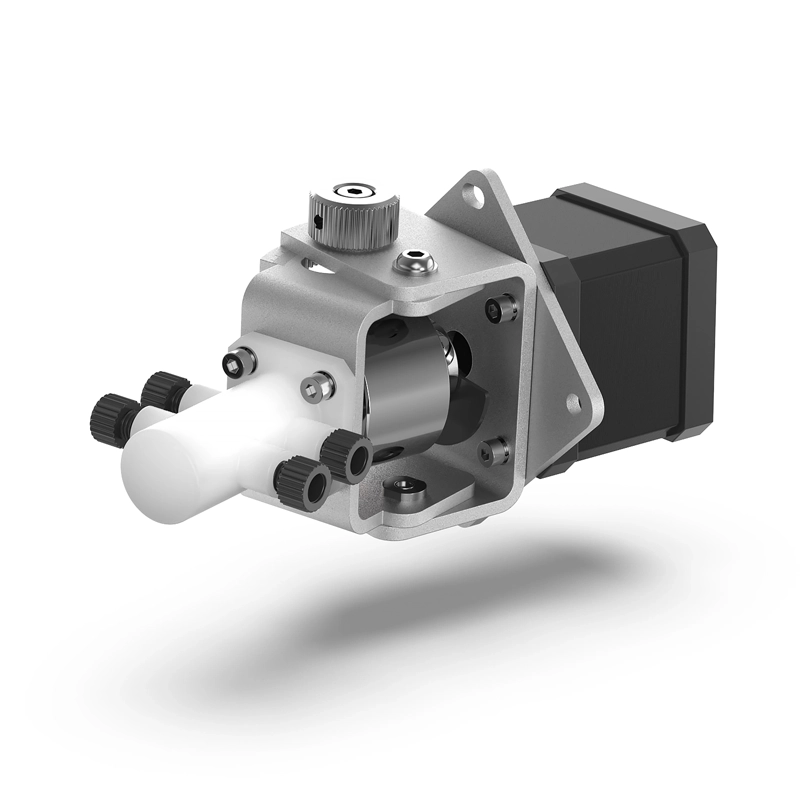
Foreach Single-head ceramic-piston valveless metering pump, 50–300 μL/rev, for reagent dispensing, titrant delivery and volumetric filling. Polyvinylidene fluoride (PVDF) head and zirconium dioxide (ZrO₂) ceramic set.
FOREACH RPL-P6.35 is a single-head ceramic-piston valveless metering pump with a displacement of 50–300 μL/rev for reagent dispensing, titrant dosing and volumetric filling. The shown configuration uses a polyvinylidene fluoride (PVDF) head and a zirconium dioxide (ZrO₂) ceramic set. Mechanical displacement adjustment and motor-speed selection match output and timing. Working-fluid and wash-fluid ports are both 1/4-28 UNF-2B, but serve different circuits; the wash circuit is for the piston area and must not be confused with the working-fluid path.
Typical Applications:
Automated analysis and in vitro diagnostics: reagent dispensing, Automatic titration: incremental titrant dosing, Reagent dispensing: microliter-to-milliliter filling stations
| Product type | RPL Single-Head Valveless Metering Pump |
|---|---|
| Displacement per revolution | 50–300 μL/rev |
| Speed | 5–300 rpm |
| Accuracy | <2% |
| Repeatability | <0.5% |
| Pressure rating | Max 150 kPa |
| Service life | 20,000,000 cycles |
| Pump head material | polyvinylidene fluoride (PVDF) |
| Plug material | polyvinylidene fluoride (PVDF) |
| Ceramic set | zirconium dioxide (ZrO₂) |
| Working-fluid port | 1/4-28 UNF-2B |
| Wash-fluid port | 1/4-28 UNF-2B |
| Overall dimensions | 78 × 78 × 145 mm |
| Weight | 750 g |
| Configuration | Custom configuration |
Displacement per revolution is not the dose or minimum reliable volume; verify actual output with the drive, liquid and circuit.
Accuracy, repeatability and life require the applicable test conditions. Confirm permitted working backpressure separately from the pressure rating.
Typical applications
RPL-P6.35 addresses single-path reagent dispensing and filling. Reagent dispensing pump, titrant dosing pump and reagent filling pump are task-based names. Its displacement range is greater than that of RPL-P4; choose against the required volume and time rather than the industry name alone.
Automated analysis and in vitro diagnostics: reagent dispensing
In automated analyzers and in vitro diagnostics (IVD) reagent circuits, liquid travels from a reagent bottle through the pump, tubing and dispensing tip into a reaction vessel. The component may be specified as a reagent dispensing pump or reagent dosing pump. Define the volume required by each analytical step and the time available to deliver it, not only the flow per minute.
Displacement and complete operating revolutions determine nominal dose volume. Calculation example: 100 μL/rev × 5 revolutions = 500 μL. At a constant 150 rpm, those revolutions take 2 seconds, excluding acceleration, stopping and other machine actions. This is a sizing calculation, not measured performance. Recalibrate output after changing the displacement setting.
Priming the working-fluid path and washing the piston area are different operations. Priming establishes a stable liquid column; the wash circuit addresses residue around the piston. For salt-containing or crystallizing reagents, select a compatible cleaning liquid and shutdown sequence. A wash port does not establish compatibility with every corrosive liquid.
Automatic titration: incremental titrant dosing
In laboratory titrators, a titrant dosing pump delivers liquid to the titration vessel under instrument control. The sequence combines an addition, mixing and electrode response, followed by the decision on the next addition. The pump supplies liquid; the instrument detects and determines the endpoint.
Specify initial delivery speed and the smallest reliable increment near the endpoint separately. At unchanged displacement and complete revolution count, reducing speed mainly increases delivery time, not dose volume. 50 μL/rev is the lower end of the displacement range, not a validated minimum titration increment. Do not infer arbitrary small doses by dividing it by motor steps.
Collect and measure repeated target increments with the actual titrant, tip and tubing. Check droplet carryover after stopping and leave time for mixing and stable readings. Drive positioning and start/stop behavior must support the required sequence; the pump accuracy specification alone is not the analytical accuracy of the complete titrator.
Reagent dispensing: microliter-to-milliliter filling stations
In repeated filling of reagent tubes and small bottles, RPL-P6.35 can be specified as a reagent filling pump or liquid dispensing pump. One fill may accumulate one or several complete operating cycles; its volume is not limited to the displacement of a single revolution. Coordinate delivery with container indexing and tip movement.
Calculation example: at 200 μL/rev, a nominal 1 mL fill requires 5 revolutions. At a constant 150 rpm, the theoretical pump running time is 2 seconds. Add indexing, tip motion and settling to obtain the station cycle. This calculation is not a verified filling rate or accuracy claim.
Test consecutive fills and restart fills using the intended tubing and tip, and inspect dripping and foaming. The polyvinylidene fluoride (PVDF) head and zirconium dioxide (ZrO₂) ceramic set must be checked against the reagent and cleaning liquid together with fittings, tubing and all other wetted components.
Define the fluidic task and configuration
Provide liquid composition, dose volume or continuous flow, allowable delivery time, daily run duration, inlet conditions, outlet backpressure and drive requirements. Use these inputs to size displacement and timing, then verify output in the actual circuit. Application directions are not claims of validation in every listed instrument.
Frequently Asked Questions
Valveless metering pump describes the pump mechanism and metering function. Reagent dispensing pump, titrant dosing pump and filling pump describe tasks within an instrument. These task names do not mean that every pump used in that application has the same mechanism.
Confirm the RPL-P6.35 configuration for your instrument
Provide liquid composition, dose volume or continuous flow, allowable delivery time, daily run duration, inlet conditions, outlet backpressure and drive requirements. Use these inputs to size displacement and timing, then verify output in the actual circuit. Application directions are not claims of validation in every listed instrument.