
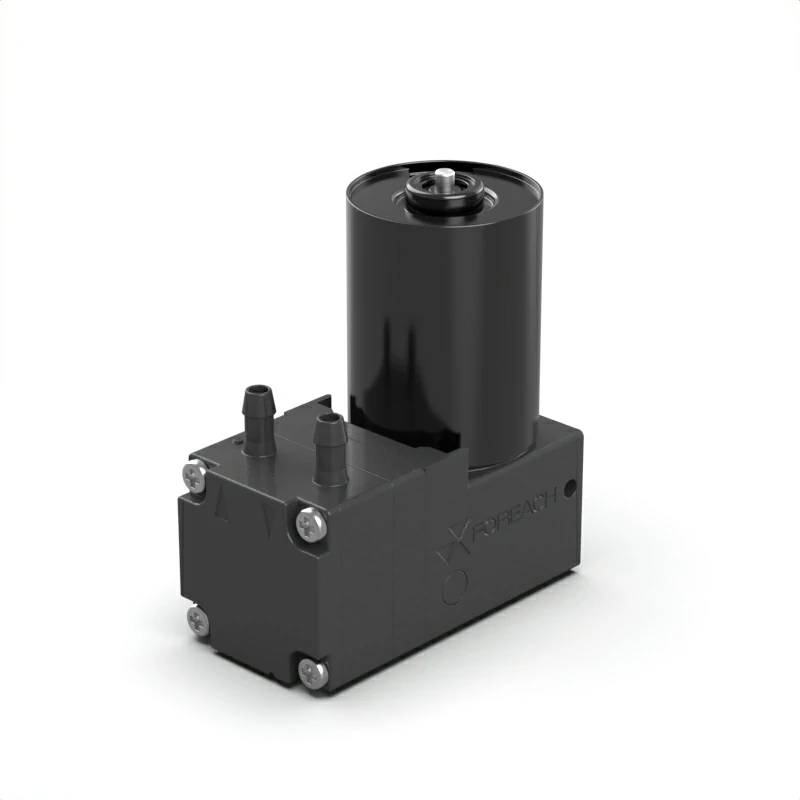
Foreach DPL60-BB 600 mL/min Brushless DC Miniature Liquid Diaphragm Pump, 10,000 h Service Life, 12 V / 24 V
The Foreach DPL60 Series Brushless Miniature Liquid Diaphragm Pump is designed for liquid transfer, with a no-load flow rate of 600 mL/min, a pressure rating of 100 kPa, a brushless motor, and a service life of 10000 h. It is suitable for cleaning-solution transfer, waste-liquid discharge, line priming, and liquid circulation, and can be selected for IVD, life science, laboratory automation, and analytical instrument applications. It is suitable for equipment that requires longer operating periods or longer maintenance intervals. Refer to the specification table below for detailed parameters. The stated service-life value applies at rated voltage under continuous operation.
Typical Applications:
Cleaning-solution transfer, waste-liquid discharge, line priming, liquid circulation
| Motor Type | Brushless DC Motor |
|---|---|
| Product Type | Miniature Liquid Diaphragm Pump |
| Rated Voltage | DC 24V ±10% / DC 12V ±10% |
| Rated Power | ≤8.4 W |
| Free-Flow Rate | 600 mL/min |
| Rated Pressure | 100 kPa |
| Self-Priming Height | 3 mH₂O |
| Working Medium | Purified water; other fluids require evaluation |
| Fluid Temperature | +5 °C–+80 °C |
| Port Size | Accepts tubing with an ID of 3.2 mm |
| Noise | ≤80 dB |
| Operating Temperature | +5 °C–+40 °C |
| Operating Relative Humidity | 30%–85% RH (Non-Condensing) |
| Pump Head Material | PP S |
| Diaphragm Material | EPDM / PTFE |
| Valve Material | EPDM / FFKM |
| Service Life | 10,000 h |
Typical Applications for a 600 mL/min Liquid Diaphragm Pump
A 600 mL/min liquid diaphragm pump is intended for instrument fluid paths that need faster liquid exchange than a 300 mL/min-class pump. Typical duties include higher-rate waste removal, washing, rinsing, circulation and larger-volume auxiliary transfer. The DPL60 brushless version combines a 600 mL/min no-load flow reference, 100 kPa rated pressure and 3 mH₂O self-priming specification with a specified service life of 10,000 h for systems requiring a longer operating-life target.
1. Higher-Flow Waste Liquid Pump for IVD and Analytical Instruments
In IVD and analytical instruments, waste liquid may need to be removed from reaction vessels, wash stations or collection manifolds within a limited process time. When the volume per cycle is higher or the drain step must be shorter, a 600 mL/min-class waste liquid pump provides more transfer capacity than a 300 mL/min-class pump.
The 600 mL/min value is a no-load reference, not the guaranteed drainage rate after installation. Suction lift, tubing ID, valves, filters and discharge back pressure must be included when determining whether the required waste-removal time can be achieved.
2. Wash and Rinse Pump for Laboratory Automation
Laboratory automation equipment may need to replace wash liquid quickly between samples, rinse probes or flow cells, or flush internal tubing after a process step. In these fluid paths the pump is commonly used as a wash solution pump or rinse pump rather than a precision dosing pump.
A 600 mL/min flow class can shorten liquid-exchange time when the tubing and downstream components allow the required flow. The 3 mH₂O self-priming specification can assist startup and bottle replacement, but a long or restrictive suction line can reduce the available flow.
3. Waste and Rinse Pump for Water and Environmental Analyzers
Online water-quality and environmental analyzers often repeat sample intake, internal rinsing and waste discharge throughout a measurement cycle. A higher-flow diaphragm liquid pump can be used in auxiliary rinse and waste paths when faster cleaning or larger liquid volumes are required.
When used with acids, alkalis, oxidizing solutions or other special media, the complete wetted-material set must be checked against concentration, temperature and contact time. High-accuracy reagent dosing should still be handled by a suitable metering technology.
4. Auxiliary Liquid Circulation Pump for Instrument Systems
Some instrument fluid paths require continuous or periodic low-pressure circulation to keep wash solution, service fluid or another compatible liquid moving between a reservoir and an internal module. In this position a 600 mL/min-class diaphragm pump can serve as an auxiliary liquid circulation pump.
This is not a high-pressure circulation pump. Actual circulation rate depends on the full circuit resistance, and the 100 kPa rated-pressure specification must not be interpreted as 600 mL/min at 100 kPa. Read the flow-pressure curve at the required operating point.
5. Automatic Refill Pump for Larger Auxiliary Reservoirs
Where an instrument uses a larger wash or service-fluid reservoir, a small automatic refill pump can restore the local level from a lower supply container. Compared with a 300 mL/min-class pump, the 600 mL/min class can reduce refill time when the fluid path has low enough resistance.
The 3 mH₂O self-priming specification helps with moderate level differences, but actual refill performance depends on fluid viscosity, suction-line length, filter resistance, discharge pressure and material compatibility.
Brushed vs Brushless Diaphragm Pump: Which Motor Version Should You Choose?
Brushed Motor
The brushed version uses mechanical brushes and a commutator for motor commutation. It is a mature and cost-effective configuration for instruments with a defined operating cycle. The specified service life of the brushed DPL60 version is 3,000 h, while actual life also depends on load, start-stop frequency, ambient temperature and the equipment duty cycle.
Long-term contact between the brushes and commutator produces wear particles inside the motor, and mechanical commutation can also generate arcing and transient electrical noise. For instruments with stricter requirements on maintenance intervals, internal cleanliness or EMC, the brushless version should also be evaluated. Brush wear occurs inside the motor and must not be described as direct contamination of the pumped liquid.
Brushless Motor
The brushless version uses electronic commutation and has no mechanical carbon brushes or brush-commutation arcing. The specified service life of the brushless DPL60 version is 10,000 h, making it more suitable for longer operating cycles, extended maintenance intervals or instruments with higher internal-cleanliness requirements.
Brushless does not mean zero electromagnetic interference. Electronic commutation and switching in the motor driver can still generate electrical noise. Final EMC performance should therefore be verified with the complete power supply, driver electronics, wiring, grounding, shielding and enclosure design.
Application Selection Note
600 mL/min is the no-load flow reference, not a fixed installed flow. The DPL60 is rated at 100 kPa, but 600 mL/min and 100 kPa are not one operating point. Determine the actual system pressure, read the flow-pressure curve and validate the complete fluid path. The brushless version has a specified 10,000 h life for longer equipment-life targets, but the actual load, temperature, switching frequency and fluid path must still be validated.
Learn more: Operating point and selection of a 600 mL/min diaphragm pump →Frequently Asked Questions
It can be used for cleaning, waste-liquid discharge, line priming, and liquid circulation in IVD, life science, laboratory automation, and analytical instruments.
Need help selecting a diaphragm pump?
Share the fluid, flow rate, pressure, self-priming requirements, wetted materials, port type, and installation space. The Foreach engineering team can help confirm a suitable diaphragm pump configuration.