
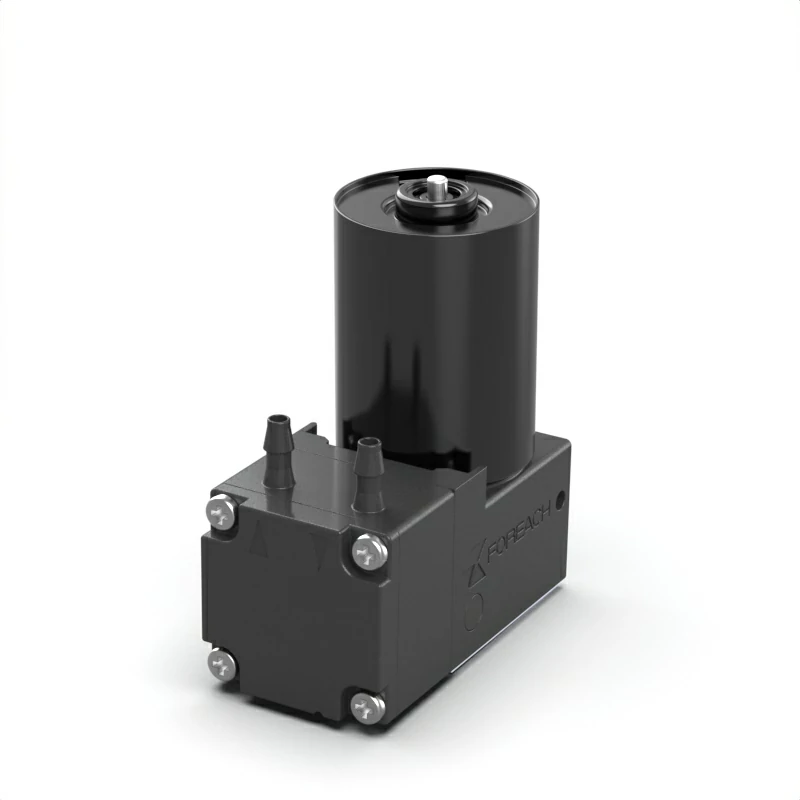
Foreach DPL30-BB 300 mL/min Brushless DC Miniature Liquid Diaphragm Pump, 10,000 h Service Life, 12 V / 24 V
The Foreach DPL30 Series Brushless Miniature Liquid Diaphragm Pump is designed for liquid transfer, with a no-load flow rate of 300 mL/min, a pressure rating of 100 kPa, a brushless motor, and a service life of 10000 h. It is suitable for cleaning-solution transfer, reagent transfer, waste-liquid discharge, line priming, and liquid circulation, and can be selected for IVD, life science, laboratory automation, and analytical instrument applications. It is suitable for equipment that requires a longer operating life and longer maintenance intervals. Refer to the specification table below for detailed parameters. The stated service-life value applies at rated voltage under continuous operation.
Typical Applications:
Cleaning-solution transfer, reagent transfer, waste-liquid discharge, line priming, liquid circulation
| Motor Type | Brushless DC Motor |
|---|---|
| Product Type | Miniature Liquid Diaphragm Pump |
| Rated Voltage | DC 24V ±10% / DC 12V ±10% |
| Rated Power | ≤8 W |
| Free-Flow Rate | 300 mL/min |
| Rated Pressure | 100 kPa |
| Self-Priming Height | 6 mH₂O |
| Working Medium | Purified water; other fluids require evaluation |
| Fluid Temperature | +5 °C–+80 °C |
| Port Size | Accepts tubing with an ID of 3.2 mm |
| Noise | ≤80 dB |
| Operating Temperature | +5 °C–+40 °C |
| Operating Relative Humidity | 30%–85% RH |
| Storage Temperature | -10 °C–+40 °C |
| Storage Relative Humidity | 10%–90% RH |
| Pump Head Material | PP S |
| Diaphragm Material | EPDM / PTFE |
| Valve Material | EPDM / FFKM |
| Service Life | 10,000 h |
Typical Applications for a 300 mL/min Miniature Liquid Diaphragm Pump
A 300 mL/min miniature liquid diaphragm pump is commonly used for fluid withdrawal, drainage, washing, return flow and auxiliary refill functions inside compact instruments. The brushless version combines the 300 mL/min flow class, 100 kPa pressure rating and 6 mH₂O self-priming specification with a specified service life of 10,000 h, making it more suitable when a longer equipment operating life or maintenance interval is required.
The same pump technology may be described by its actual function in different systems, such as a waste liquid pump, wash solution pump, waste ink pump, ink return pump or small refill pump.
1. Waste Liquid Pump for IVD, Clinical Chemistry and Hematology Analyzers
In IVD, clinical chemistry and hematology analyzers, reaction waste, wash solution and residual sample fluid must be transferred from reaction vessels, probes or waste manifolds to a waste container. At this point in the fluid path, the pump is primarily a waste liquid pump rather than a metering pump.
Waste lines may contain both air and liquid, so the pump must be able to re-establish suction after standby, air entry or bottle replacement. A self-priming diaphragm pump is well suited to this duty. A 300 mL/min flow class can support periodic drainage in compact analyzers, while actual discharge rate still depends on suction height, tubing ID, valves and total system resistance.
2. Wash Solution Pump for Laboratory Automation
In automated liquid handling, sample preparation and laboratory analyzers, wash solution is transferred from a reservoir to probes, reaction vessels, flow cells or internal tubing to remove sample and reagent residues. This fluid path is focused on supplying, flushing and replacing liquid rather than high-accuracy volumetric dosing.
A micro liquid pump can supply wash solution, flush tubing and prime the fluid path after startup or bottle replacement. The 300 mL/min flow class provides a practical balance between washing speed and compact installation, while self-priming helps the system recover when the inlet line is not completely filled with liquid.
3. Waste Liquid and Rinse Pump for Water and Environmental Analyzers
Online water-quality, environmental and chemical analyzers often contain separate paths for sample, reagent, rinse solution and waste liquid. High-accuracy reagent dosing is normally handled by a metering pump, while waste removal, internal rinsing and general fluid transfer can be handled by a diaphragm liquid pump.
In a drainage path it functions as a waste liquid pump; in an internal cleaning path it functions as a rinse or wash solution pump. Acids, alkalis, oxidizing liquids and special reagents require compatibility checks based on concentration, temperature and contact time with the pump head, diaphragm and valves.
4. Waste Ink and Ink Return Pump for Inkjet Printers
Auxiliary ink circuits in inkjet printers may need to remove waste ink after printhead cleaning, recover excess ink or maintain return flow between the printhead and ink reservoir. A pump used to discharge cleaning residue is commonly described as a waste ink pump, while a pump returning excess ink to the reservoir may be used as an ink return or recirculation pump.
Diaphragm pumping is suitable for auxiliary ink paths where air and liquid may alternate, but ink and cleaning-fluid chemistries vary widely. Wetted-material compatibility, flow stability and service life must be validated before use. This application refers to auxiliary waste and return paths, not high-pressure printhead ink delivery.
5. Automatic Refill Pump for Compact Equipment
Compact instruments may use a small auxiliary pump to replenish wash liquid, coolant or another service fluid from a lower reservoir when the local tank level falls. Working with a level sensor or controller, a self-priming liquid pump can draw fluid from the reservoir and restore the required level without manual priming.
The 6 mH₂O self-priming specification is useful when the reservoir is below the pump, but actual refill performance still depends on fluid viscosity, suction-line length, filter resistance, discharge pressure and wetted-material compatibility.
Brushed vs Brushless Diaphragm Pump: Which Motor Version Should You Choose?
Brushed Motor
The brushed version uses mechanical brushes and a commutator for motor commutation. It is a mature and cost-effective configuration for instruments with a defined operating cycle. The specified service life of the brushed DPL30 version is 3,000 h, while actual life also depends on load, start-stop frequency, ambient temperature and the equipment duty cycle.
Long-term contact between the brushes and commutator produces wear particles inside the motor, and mechanical commutation can also generate arcing and transient electrical noise. For instruments with stricter requirements on maintenance intervals, internal cleanliness or EMC, the brushless version should also be evaluated. Brush wear occurs inside the motor and must not be described as direct contamination of the pumped liquid.
Brushless Motor
The brushless version uses electronic commutation and has no mechanical carbon brushes or brush-commutation arcing. The specified service life of the brushless DPL30 version is 10,000 h, making it more suitable for longer operating cycles, extended maintenance intervals or instruments with higher internal-cleanliness requirements.
Brushless does not mean zero electromagnetic interference. Electronic commutation and switching in the motor driver can still generate electrical noise. Final EMC performance should therefore be verified with the complete power supply, driver electronics, wiring, grounding, shielding and enclosure design.
Application Selection Note
300 mL/min is a flow value measured under specified test conditions and is not a fixed output in every installed system. Suction height, tubing diameter and length, filters, solenoid valves, fittings and discharge back pressure all change system resistance and therefore the actual operating point. For the brushless version, the specified 10,000 h life can support longer equipment-life targets, but the final duty cycle, load, temperature and installed fluid path still require validation.
Learn more: Operating point and selection of a 300 mL/min diaphragm pump →Frequently Asked Questions
It can be used to transfer cleaning solutions, reagents, waste liquids, and other liquids in instrument fluid paths. Before selection, confirm the compatibility of the liquid with the diaphragm, valves, pump head, and other wetted materials.
Need help selecting a diaphragm pump?
Share the fluid, flow rate, pressure, self-priming requirements, wetted materials, port type, and installation space. The Foreach engineering team can help confirm a suitable diaphragm pump configuration.