
How to Select a High-Pressure Diaphragm Pump: DPL30H 300 mL/min and 600 kPa Guide
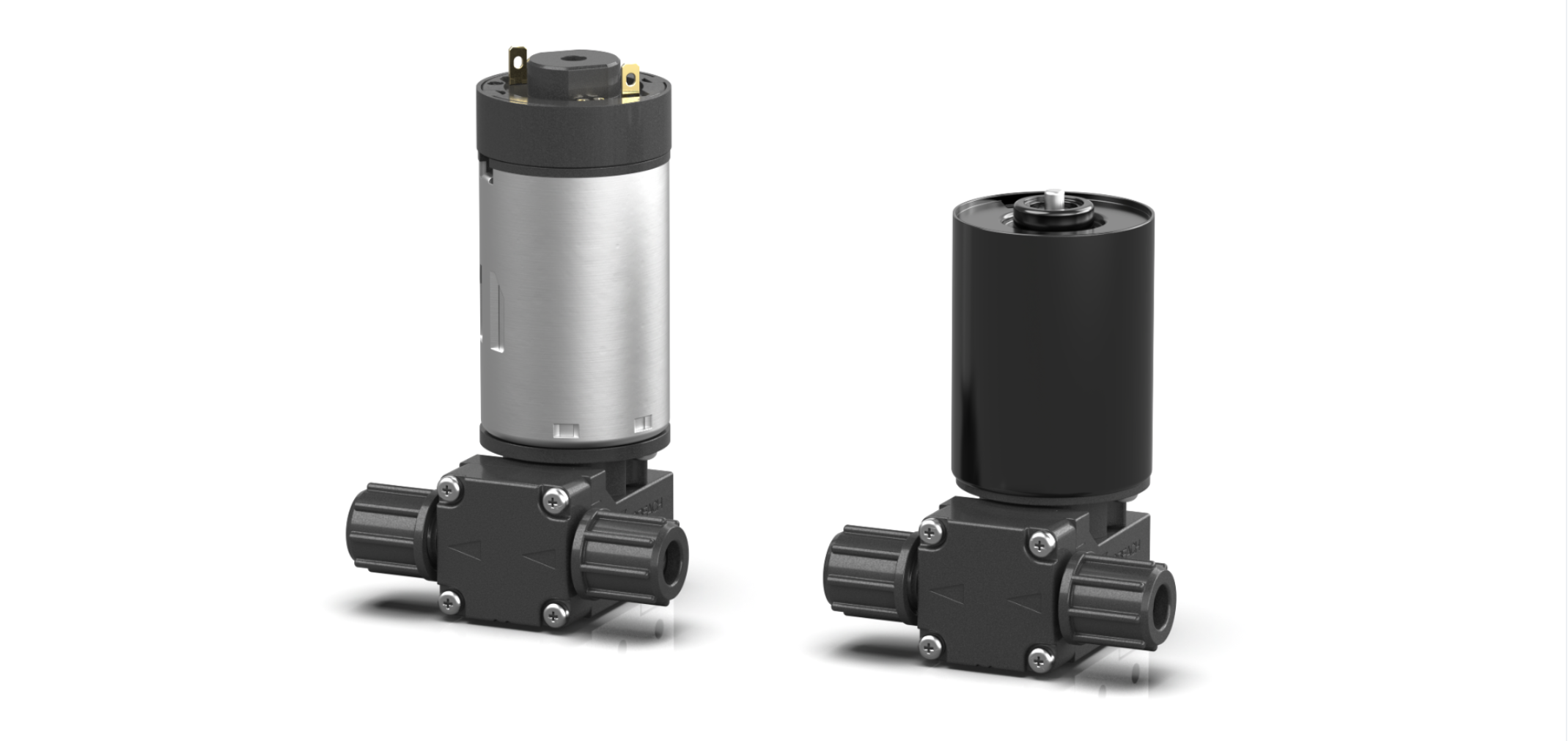
1. Why high-backpressure fluid paths need a different pump
Filters, narrow rigid tubing, valves, mixing chambers and long lines all create pressure drop. As backpressure rises, a pump's delivered flow falls, so no-load flow alone is not a valid selection criterion. DPL30H is designed for liquid paths that need greater pressure margin: 300 mL/min no-load flow and 600 kPa rated pressure.
DPL30H supports self-priming and liquid-gas isolation in higher-backpressure equipment. Its rated medium is purified water; any other liquid must be evaluated under the actual concentration, temperature, exposure time, pressure and lifetime conditions.
It is not merely an enlarged standard diaphragm pump. Pressure capability, rigid-tube connection, wetted materials and motor control must be treated as one system boundary.
2. Confirm six application inputs first
Define the fluid path before decoding the model number.
| Input | What to define | Why it matters |
|---|---|---|
| Target flow | Required continuous flow at target backpressure | The 300 mL/min no-load value is not the operating-point flow |
| System backpressure | Total drop across filters, valves, tubing, chambers and elevation | Sets the pressure the pump must overcome |
| Medium | Identity, concentration, temperature and cleaning fluids | Used to screen EP/PS or FF/PS |
| Fluid line | 6×4 mm (OD×ID) rigid tubing and every fitting | Reliability depends on the whole line |
| Control | On/off only, or speed, direction and tachometer feedback | Determines brushed or five-wire brushless motor |
| Lifetime | Daily runtime, continuous/intermittent duty and service interval | Shapes motor choice and validation |
3. 300 mL/min and 600 kPa are not one operating point
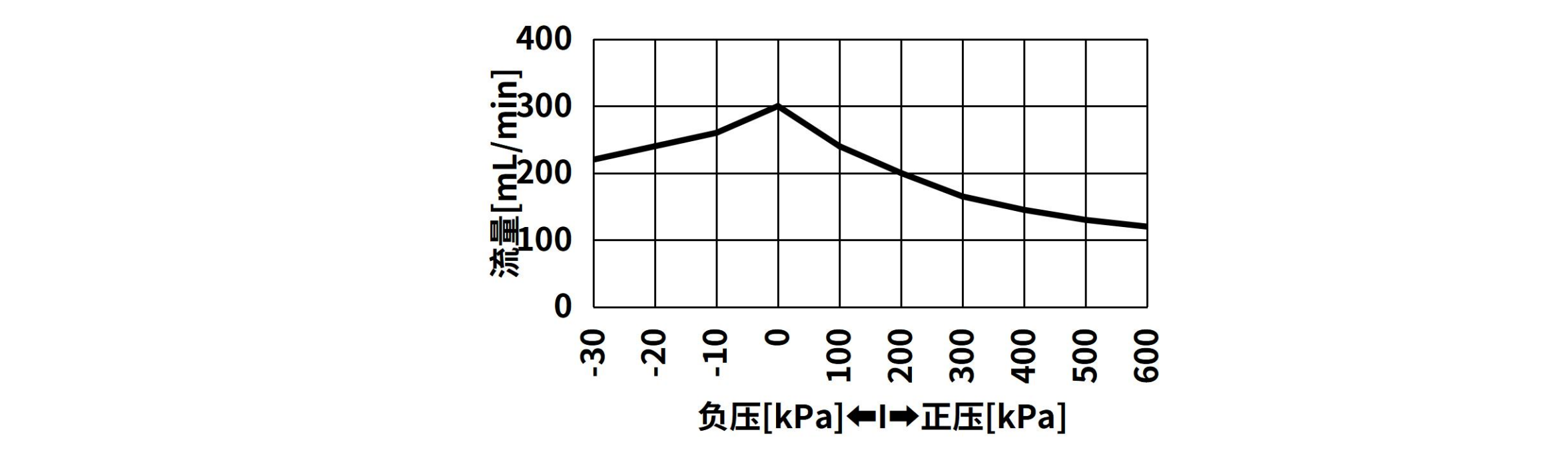
300 mL/min is the DPL30H no-load flow rating. 600 kPa is its rated pressure. These values describe different ends of pump performance and must never be combined into a claim of 300 mL/min at 600 kPa.
Delivered flow decreases as positive outlet pressure increases. Start with the target backpressure, read the available flow from the official curve, then allow margin for system variation, filter loading and unit-to-unit tolerance.
300 mL/min is no-load flow; 600 kPa is rated pressure. They are not the same operating point.
4. DPL30H specifications and application boundaries
Use these values for initial screening, then confirm the exact model against the medium, line and controls.
| Parameter | DPL30H | Selection note |
|---|---|---|
| No-load flow | 300 mL/min | Not a guaranteed value at 600 kPa |
| Rated pressure | 600 kPa | Use the flow-pressure curve for the operating point |
| Self-priming height | 3 mH₂O | Actual lift depends on medium, tubing and sealing |
| Power | ≤7 W | Size the supply for starting and running |
| Rated medium | Purified water | Evaluate other liquids under actual conditions |
| Medium temperature | +5°C to +40°C | Do not apply the DPL30 +80°C limit |
| Connection | Threaded Port, connects to 6 × 4 mm rigid tubing | Check the lowest-rated part in the line |
| Noise | ≤80 dB | Equipment structure affects system noise |
| Pump head | Polyphenylene sulfide (PPS) | Diaphragm and valve materials vary by model |
| Diaphragm | EPDM or PTFE, by model | No material is universal |
| Valve | EPDM or FFKM, by model | Validate against medium and temperature |
5. DPL30 vs DPL30H: the same no-load flow, different roles
Both pumps are rated at 300 mL/min no-load flow, but their pressure, self-priming, tubing and temperature boundaries differ. DPL30H is a separate high-backpressure, rigid-tube platform—not a simple DPL30 upgrade.
| Item | DPL30 | DPL30H |
|---|---|---|
| No-load flow | 300 mL/min | 300 mL/min |
| Rated pressure | 100 kPa | 600 kPa |
| Self-priming height | 6 mH₂O | 3 mH₂O |
| Tubing | ID 3.2 mm flexible tubing | Threaded Port, connects to 6 × 4 mm rigid tubing |
| Maximum medium temperature | +80°C | +40°C |
| Primary selection focus | Lower pressure, suction lift and higher temperature limit | High backpressure, rigid line and system pressure rating |
For approximately 100 kPa service, ID 3.2 mm flexible tubing and a higher medium-temperature limit, read the DPL30 liquid diaphragm pump selection guide.
6. Reading the DPL30H flow-pressure curve
The official curve shows flow near 300 mL/min when outlet pressure is near zero. Flow then falls as positive pressure rises. The pump still delivers in the high-backpressure region, but below its no-load flow.
Use the curve to identify a candidate operating region, not as a substitute for equipment validation. Include end-of-life filter drop, valve-switching transients, tubing tolerances and the required flow margin.
7. 6×4 mm rigid-tube connection: the lowest-rated component governs
Threaded Port, connects to 6 × 4 mm rigid tubing. Confirm tubing material and OD tolerance, square cut and insertion depth, then perform pressure-hold and leak tests.
The high-backpressure line may also contain fittings, valves, filters, sensors and chambers. The pump rating cannot replace the pressure qualification of those components.
The allowable system pressure is set by the lowest-rated component in the complete fluid path.
8. Brushed and brushless versions: size, lifetime and control
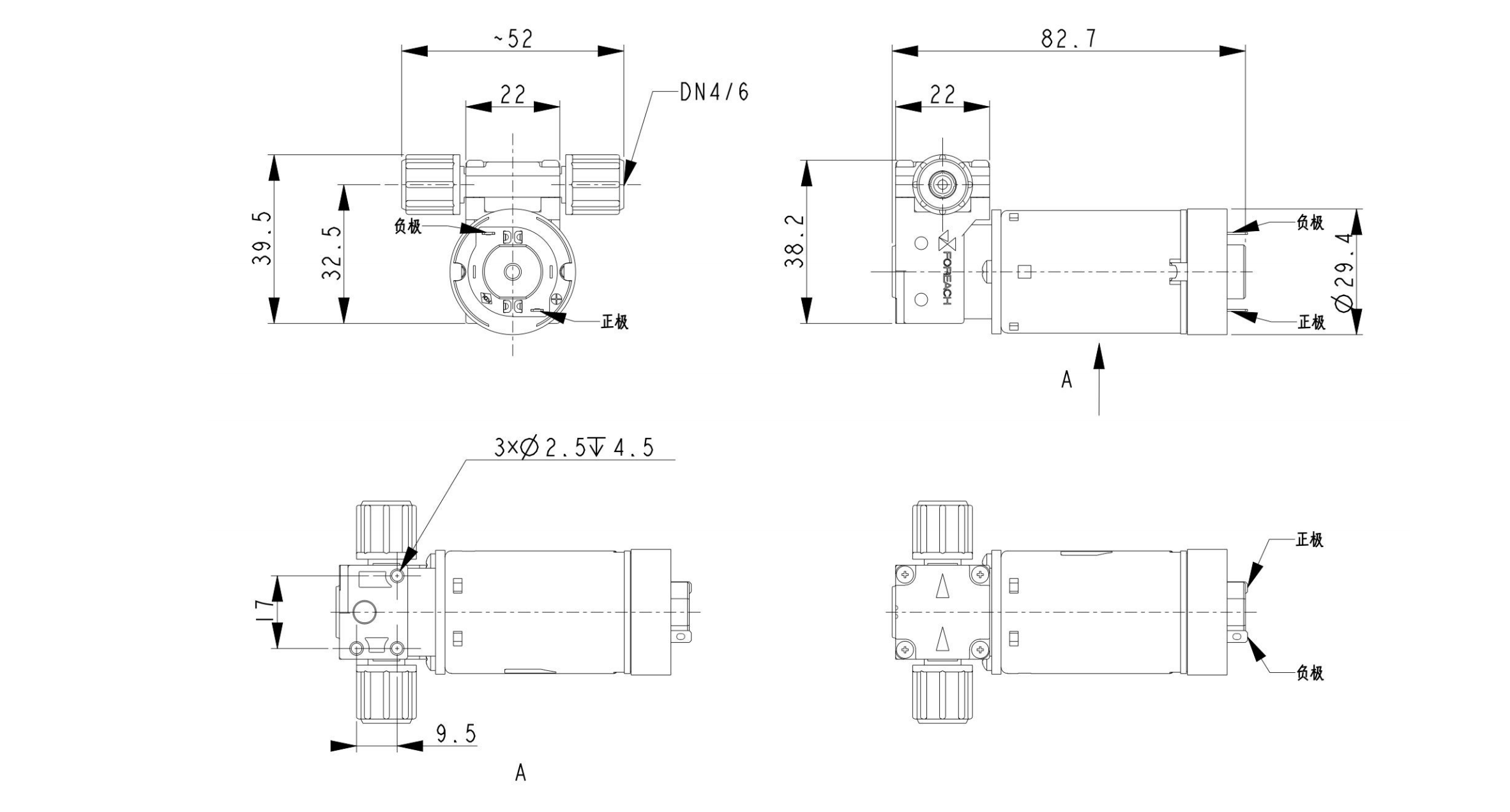
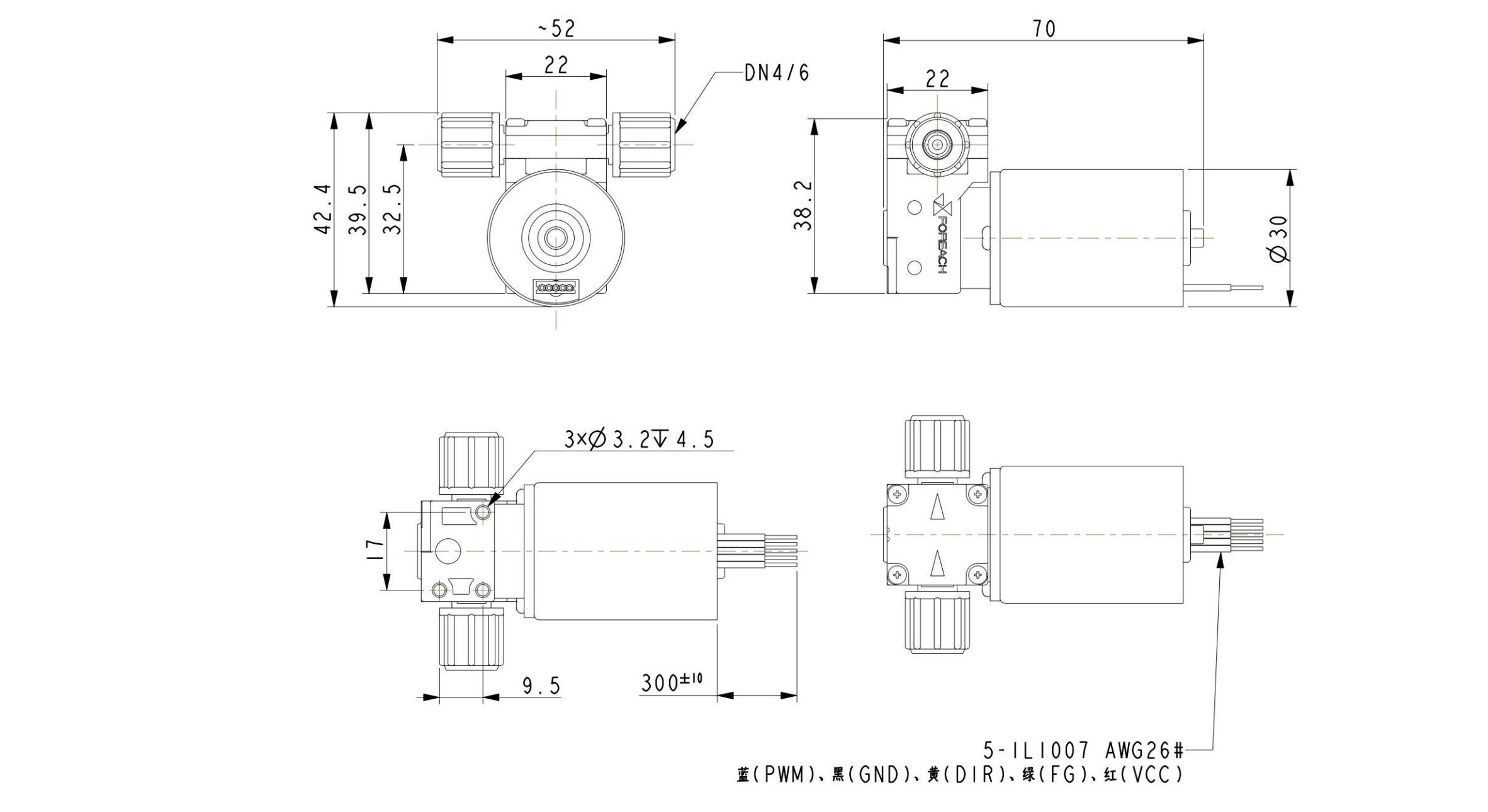
The brushed version supports straightforward 12/24 V power switching. The five-wire brushless version adds direction, speed command and tachometer feedback. Their envelopes differ, so verify each mechanical drawing in the equipment layout.
Lifetime is specified at rated voltage in continuous operation. Backpressure, cycling, ambient temperature, medium and heat dissipation can all change field life.
| Item | Brushed | Brushless |
|---|---|---|
| Rated voltage | 12 V or 24 V | 12 V or 24 V |
| Approx. weight | 135 g | 155 g |
| Reference lifetime | 3000 h | 10000 h |
| Lifetime condition | Continuous at rated voltage | Continuous at rated voltage |
| Control | Power on/off | Direction, PWM/0–5 V speed, FG feedback |
Five-wire brushless interface
The controller must respect the voltage ranges, floating states and FG decoding requirements.
| Signal | Color | Function |
|---|---|---|
| VCC | Red | Power positive |
| GND | Black | Ground |
| DIR | Yellow | High or open: CW; low: CCW |
| FG | Green | Speed signal |
| PWM | Blue | Speed command |
- 0–0.25 V on PWM stops the pump.
- PWM floating or 4.5–5 V commands full speed.
- Speed is adjustable by PWM or 0–5 V analog voltage; speed is proportional to PWM duty cycle.
- FG outputs three square-wave pulses per rotor revolution.
9. Selecting EP/PS or FF/PS wetted materials
The suffix identifies a wetted-material set; it is not a blanket compatibility promise for every chemical.
| Code | Diaphragm | Valve | Head | Initial screening logic |
|---|---|---|---|---|
| EP/PS | EPDM | EPDM | PPS | Start from purified-water service, then check actual compatibility |
| FF/PS | PTFE | FFKM | PPS | Candidate for a different diaphragm/elastomer set; validation is still required |
Evaluate chemical identity, concentration, temperature, pressure, exposure time and target life; test samples when needed.
10. Model code and complete selection sequence
DPL30H combines voltage, motor, connection, port direction, materials and customization in its model code.
This explanation applies to DPL30H only and is not inferred from DPL60 or another series.
| Field | Values | Meaning |
|---|---|---|
| Voltage | 24 / 12 | 24 V or 12 V |
| Motor | D / B / C | D brushed, B brushless, C coreless |
| Connection | S | Connection defined by the specification |
| Port direction | C / 3 / 6 / 9 | C default upward, 3 right, 6 down, 9 left |
| Materials | EP/PS / FF/PS | EPDM+EPDM+PPS, or PTFE+FFKM+PPS |
| Customization | X | Custom requirement |
Recommended selection sequence
- Define the operating point
Specify required flow at target backpressure, not just no-load flow.
- Calculate total pressure drop
Include end-of-life filters, valves, rigid tubing, chambers and elevation.
- Check every pressure rating
Set the system limit by the lowest-rated part and run a pressure-hold test.
- Choose materials
Screen EP/PS or FF/PS and validate with the real medium.
- Choose motor and voltage
Use switching, speed, direction, FG, lifetime and power needs.
- Validate a prototype
Record flow, pressure, temperature rise, noise, leakage and lifetime trend.
Conclusion: select DPL30H by flow at target backpressure
DPL30H should not be presented as an exaggerated combination of 300 mL/min and 600 kPa. Its value is verifiable pressure margin for high-backpressure liquid paths, a 6×4 mm rigid-tube connection and clear motor/material options.
If the priority is a higher 400–600 mL/min no-load flow rather than 600 kPa-class pressure, compare DPL60. If DPL30H is the right platform, validate it against the curve, the lowest-rated line component and the actual medium.
If the priority is 400–600 mL/min-class higher flow rather than high pressure, read the DPL60 liquid diaphragm pump selection guide.
Visit the DPL30H high-pressure liquid diaphragm pump series page for brushed and brushless product details.
Browse the diaphragm pump category to compare other flow and pressure ranges.